
5 Signs Your Transport Procurement Is Less Under Control Than You Think
- Apr 28
- 4 min read
Industrial companies managing freight across multiple plants and transport modes have usually built the right foundations: carrier contracts negotiated, processes established, teams that know the operation inside out. What tends to lag behind is the information layer, the real-time picture of whether those foundations are holding across every mode, every shipment, every site. These five signs are worth checking.

Sign 1: Each Transport Mode Lives in a Different Place
Road freight moves through your TMS. Air freight is coordinated by email with a freight forwarder. Sea shipments go through a broker. Parcels are booked directly through a carrier portal. Each mode has its own entry point, its own data trail, and its own communication chain.
The result is a fragmented picture. No one in your organization has a complete view of what is moving, by what mode, in real time. Decisions happen in silos. The logistics manager handling an urgent road shipment has no visibility into whether the same lane could have been served by a pre-negotiated parcel service at a fraction of the lead time, because that information lives somewhere else.
This is not just an operational inconvenience. Modal fragmentation makes it structurally impossible to balance your freight intelligently. You cannot compare options you cannot see. As we explored recently, the teams that absorb disruption fastest are the ones with pre-qualified capacity across all modes, not the ones still deciding which mode to use when the problem has already arrived.

Sign 2: You Have Pre-Negotiated Rates but No Way to Confirm They Are Being Used
Your procurement team has done the work. Contracts are in place. Rates are agreed. Carriers are selected and approved. But when an urgent shipment comes in on a Friday afternoon, what actually happens?
Someone calls a familiar carrier. Or sends a quick email. Or books through a portal that bypasses the agreed process entirely. The shipment moves. The invoice arrives later, sometimes at the right rate, sometimes not.
If confirming that your pre-negotiated contracts are being executed requires checking emails, calling someone, or waiting for a month-end report, that is a visibility gap. The contract exists on paper. Whether it is being followed is a different question entirely.
This is one of the most common and least discussed sources of procurement drift, not because teams act in bad faith, but because fragmented processes make it easy to go off-contract and hard to notice when it happens.
Sign 3: Your Tracking Data Depends on Carrier Cooperation
Knowing where a shipment is should not require a negotiation. But for most logistics teams, tracking status means logging into multiple carrier portals, some of which update automatically, some of which need a manual refresh, and some of which only send alerts when something has already gone wrong.
ETAs, GPS coordinates, milestone confirmations, and carrier contacts are spread across systems and inboxes. Your team spends time chasing updates that should come to them automatically. Exceptions (delays, missing documentation, customs holds) surface late, when the options left to act are limited.
Real visibility means having all tracking data in one place, regardless of mode, regardless of carrier. Not because a unified dashboard looks better on a slide, but because it changes what you can actually do when a shipment deviates from plan.
Sign 4: You Only Know Your Modal Split When Finance Closes the Books
What percentage of your freight moved by road versus air versus sea last month? How many shipments used pre-negotiated rates versus spot versus parcel services? If the honest answer involves waiting for a finance report or asking someone to pull a spreadsheet together, your modal balance is invisible to you in real time.
Modal decisions, when to use road, when to escalate to air, when to trigger a pre-negotiated rate versus open a mini-tender, should be driven by live data. They rarely are. Not because the data does not exist, but because it lives across too many systems to be usable at the moment a decision needs to be made.
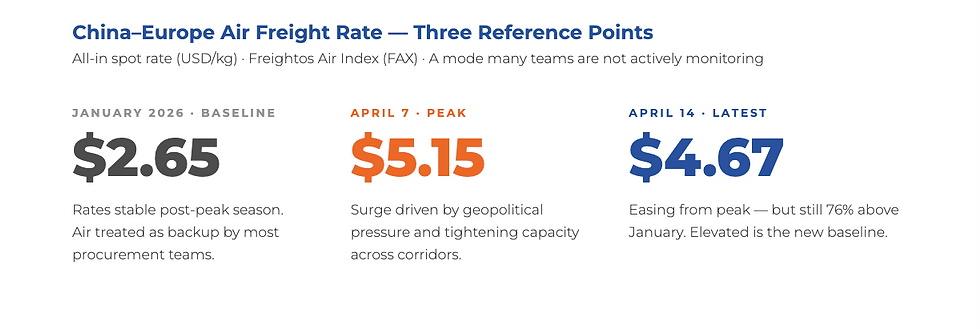
The consequence is reactive modal management. Modes get selected by habit or by whoever picks up the phone first, not by what the freight actually requires. Consider air freight: according to the Freightos Air Index (FAX), all-in spot rates on the China–Europe lane nearly doubled between January and April 2026, rising from around $2.65/kg to a peak of $5.15/kg in early April. Teams without real-time cross-modal visibility did not see that shift coming, and had no benchmark to decide when switching modes made sense.
Sign 5: Carrier Performance Is Measured by Reputation, Not by Data
Some carriers are trusted. Others are avoided. That institutional knowledge has value, but it is not a performance management system.
Without a centralized view of delivery performance across all modes and all carriers, benchmarks only exist in people's heads. You cannot systematically identify which lanes underperform. You cannot compare two carriers serving the same route. You cannot tell whether your most-used carrier last quarter is still the right choice this quarter.
Performance management requires data. Data requires centralization. And centralization requires having all your freight activity (spot, pre-negotiated, contract, parcel) feeding into the same environment, where it can be measured consistently.
This is precisely where platforms like Easy4Pro change the equation: by consolidating all purchasing modalities and transport modes in one place, freight data stops being scattered across tools and starts becoming something you can act on. Teams that once managed transport reactively gain the visibility to make proactive, informed modal decisions, across every mode, every carrier, every shipment.

What Control Actually Looks Like
Control in transport procurement does not mean fewer carriers or simpler routes. It means having one consistent picture of everything that moves (across all modes, all modalities, all carriers) in real time.
That picture lets you execute your procurement strategy as designed, balance modalities based on data rather than habit, and catch deviations early enough to do something about them.
If any of the five signs above felt familiar, the gap is worth examining, not because something is broken today, but because the decisions you make tomorrow depend on information you may not yet have.
Sources: Gartner Supply Chain Research, 2026 · Freightos Air Index (FAX), Greater China to Europe, April 2026 · IATA Air Cargo Statistics, Jan–Feb 2026 & 2026 Outlook · ITS Logistics April Supply Chain Report, April 23, 2026 · IRU Road Freight Market Outlook, 2026 · All figures current as of publication date and subject to revision.


